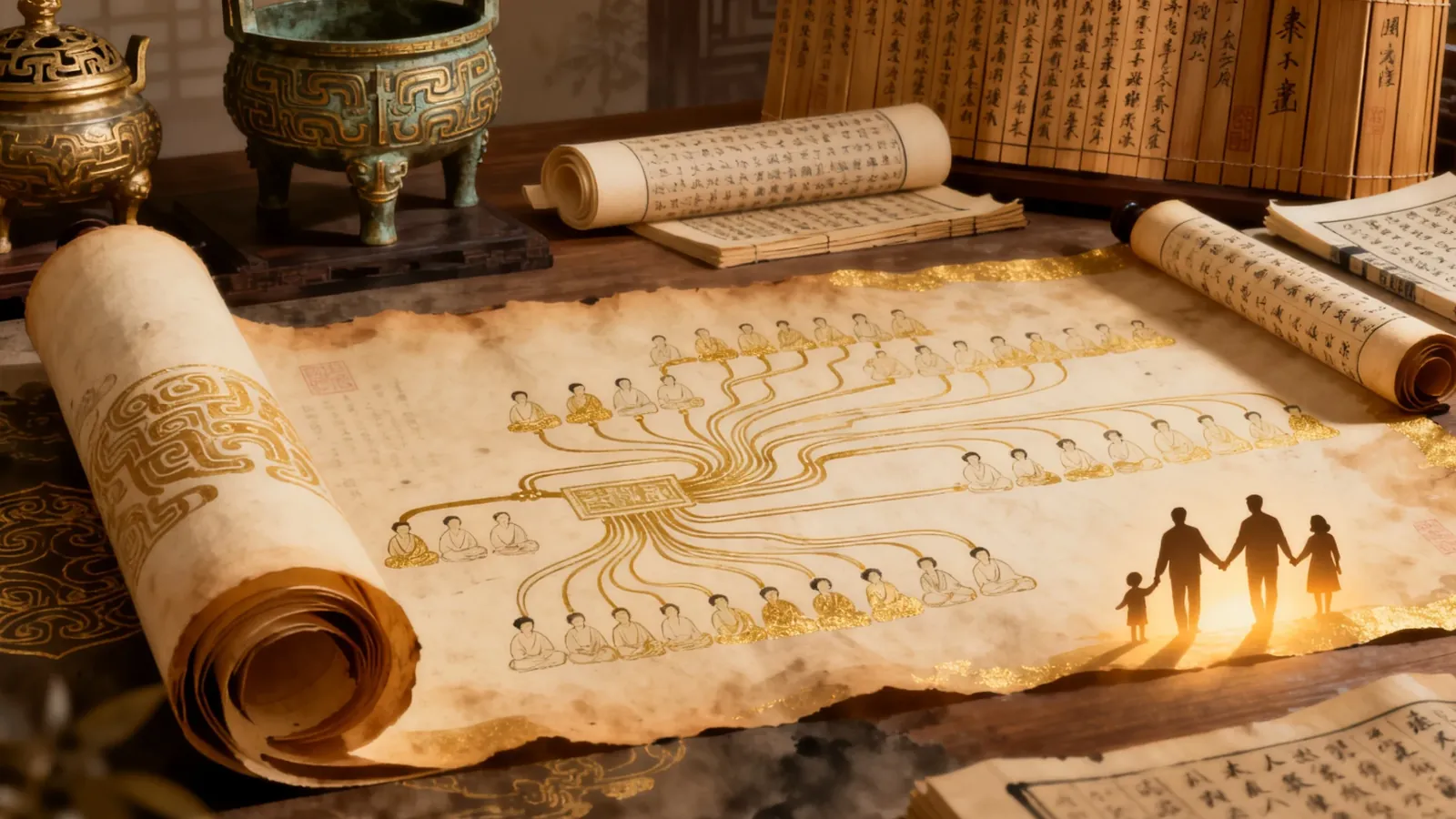
No people in the world are as obsessed with “who am I” as the Chinese.
The concept of family in China has continued for three thousand years. From the Western Zhou “lineage records” to today’s “AI family trees,” forms have changed in countless ways, but the core need has never changed: remembering who we are and where we come from.
This article deconstructs the three layers of reasons why Chinese family trees have endured, from a sociological perspective.
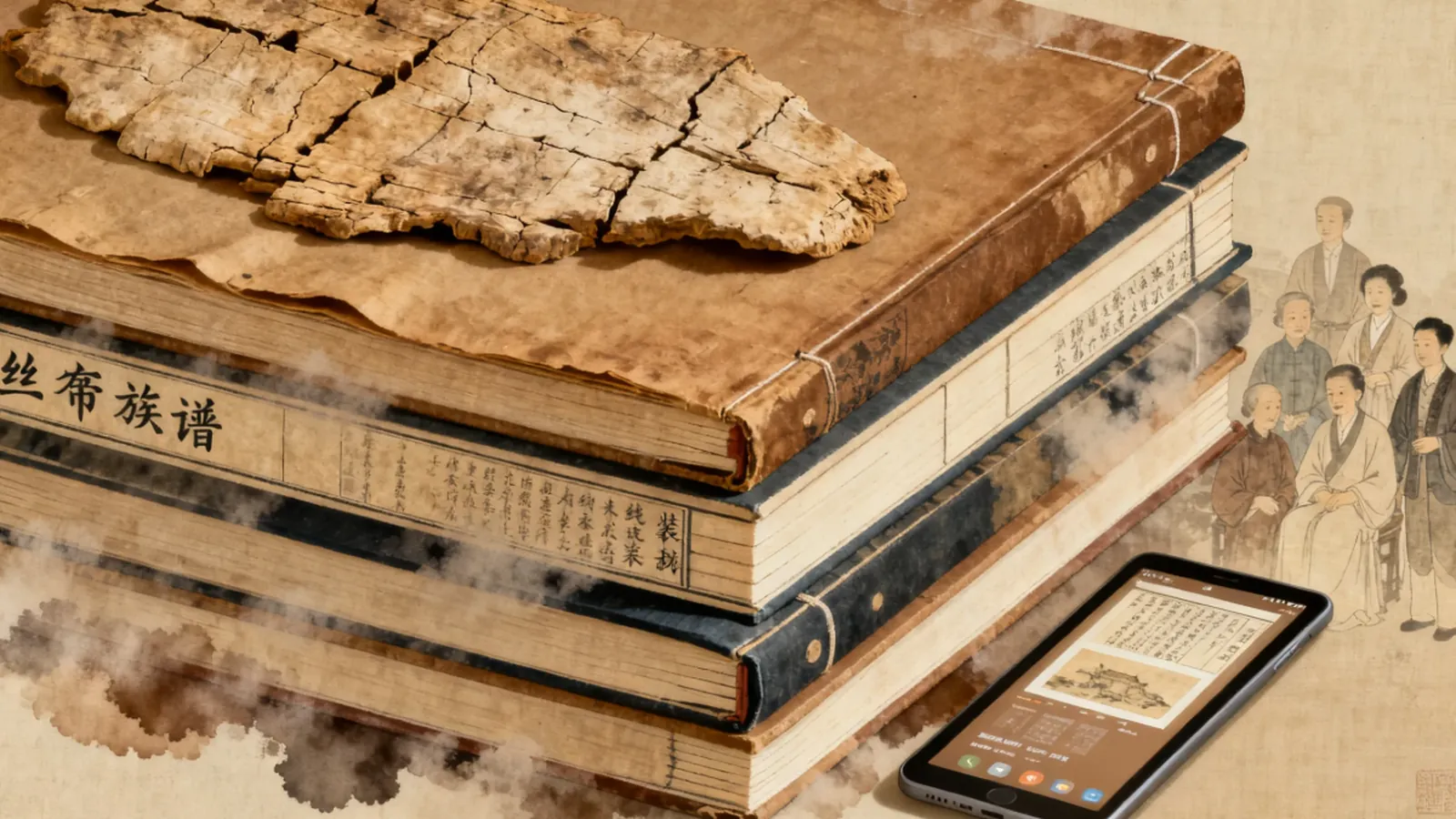
1. A False Premise: Did Family Trees Really “Last 3,000 Years”?
Strictly speaking, the form of Chinese family trees undergoes major revolutions every few hundred years:
- Western Zhou: “Lineage” (national archives)
- Wei-Jin: “Gatekeeper clan genealogies” (aristocratic credentials)
- Song-Yuan: “Ouyang-Su styles” (folk compilation)
- Ming-Qing: “Standardized genealogies” (ancestral hall culture)
- Modern: “Electronic family trees” (AI-assisted)
The only constant is the core need to “record family lineages.”
So “3,000 years of continuity” is more accurately understood as: this core need has continued for 3,000 years, while the form has continuously evolved.
2. First Layer: Institutional Support
The first reason family trees endure is that the state treated them as governance tools.
Key Institutional Milestones
| Dynasty | Institution | Role |
|---|---|---|
| Western Zhou | Minor Historian managing “lineage” | National archive-ization |
| Qin-Han | Household registration + clans | Combined with population management |
| Wei-Jin | Genealogy officials | Determining clan status, careers |
| Tang | Records of Surnames | Controlling aristocratic power |
| Song | Folk compilation legalized | Family trees go to the masses |
| Ming-Qing | Dual-track of household + genealogy | Grassroots governance tool |
Why did the state need family trees? Because ancient China was “imperial power doesn’t reach the county” — the central government couldn’t manage grassroots. Clans were the middle layer between state and individuals, taking on many governance functions (taxation, disputes, disaster relief, education).
The family tree, as the clan’s “constitution,” was naturally recognized and encouraged by the state.
3. Second Layer: Cultural Genes
The deeper reason is cultural genes — Chinese people have an almost instinctive obsession with “ancestors,” “bloodline,” and “inheritance.”
3.1 Filial Piety Ethics
“Be cautious at the end and pursue the distant past; the people’s virtue will become thick.” — Analects · Xue Er
Filial piety is the cornerstone of Chinese culture, and one of its cores is “not forgetting ancestors.” The family tree is the concrete practice of “not forgetting ancestors.”
Ancient officials had to observe “Ding You” (mourning for three years) when parents died; any major decision had to “inform the ancestral temple” first; destruction of family trees was “the greatest unfilial act.”
3.2 Falling Leaves Return to Roots
Chinese agrarian civilization shaped the tradition of “loving one’s home and reluctant to move.” A family often lived in one place for hundreds of years — family = hometown = land.
The family tree reinforced this sense of “root” — your ancestors are buried here, and you will be too. The family tree is the spiritual bond connecting “the living” and “the dead.”
3.3 Glorifying Ancestors
Confucianism emphasizes “establishing conduct, following the way, spreading fame in later generations, to glorify parents.” Glorifying ancestors is a deeply ingrained life driver.
The family tree is the concrete recording method of “spreading fame.” Outstanding family members are documented in detail; conversely, evildoers are expelled (“removed from clan”).
3.4 Collective Memory
Chinese people have a strong collective memory need. Family trees, village records, clan rules, proverbs — all are carriers of collective memory.
In the long river of history, individual life is short and fragile — only by integrating into family memory does the individual achieve “immortality.”
4. Third Layer: Psychological Needs
The deepest reason is psychological needs — family trees satisfy several basic psychological needs of humans.
Maslow’s Hierarchy Perspective
| Level | Need | How Family Trees Satisfy |
|---|---|---|
| Physiological | Survival security | Ancient family trees attached to clan mutual aid |
| Security | Identity protection | Family trees prove blood, social status |
| Social | Belonging | Family trees strengthen family identity, belonging |
| Esteem | Self-worth | Family trees record personal contributions, recognition |
| Self-actualization | Immortality | Family trees let life integrate into larger narrative |
Modern psychology research confirms: children who know their family stories have stronger resilience when facing setbacks, clearer identity, and better psychological health. Family trees are a “psychological vaccine.”
5. East-West Family Tree Culture Comparison
Why are Chinese so obsessed with family trees while Westerners seem less so? Because Chinese and Western family structures have fundamental differences.
| Dimension | China | West |
|---|---|---|
| Family structure | Extended family living together, multiple generations | Nuclear family, children move out as adults |
| Residence pattern | Paternal/maternal generations at home, children migrate | Children move out independently, geographically scattered |
| Surname tradition | Surnames passed unchanged for thousands of years | Surnames can change, can combine husband’s |
| Cultural carriers | Family tree, ancestral hall, family instructions | Bible, family albums, oral |
| Religious function | Ancestor worship | Monotheism (God as Father) |
| Psychological projection | “I’m a descendant of X family” | “I’m a child of God” |
Core difference:
- Chinese family is a blood group (based on biological blood)
- Western family is more of a contractual group (based on marriage choice)
While Westerners also have family tree traditions (especially among nobility), their obsession with “ancestors” is far less than Chinese. This is directly related to the monotheistic “God as Father” concept — their “root” is in heaven, not on earth.
6. Contemporary Chinese Family Tree Revival: Growing From Ruins
Since the 1980s, Chinese family trees have experienced a significant revival.
Three Signs of Revival
- Quantity surge: New family tree compilations grew from dozens in 1980 to hundreds per year after 2010
- Digitization: Local archives, libraries, FamilySearch and other institutions are large-scale digitizing old genealogies
- Academic development: Genealogy studies became a branch of history and sociology, with dedicated researchers at multiple universities
Three Driving Forces
| Driving Force | Manifestation |
|---|---|
| Policy support | Local history compilation, traditional culture revival |
| Economic conditions | Compilation cost dropped from ten-thousands to hundreds |
| Tool popularization | Family tree software, genetic testing, online collaboration |
The most critical change: the main body of compilation changed from “family authority” to “ordinary people.” Today’s family tree compilers aren’t necessarily clan leaders — they can be any dedicated family member.
7. Family Tree Form Predictions for the Next 50 Years
Family trees won’t disappear; they’ll instead be reborn in new forms. Several trends:
Trend 1: AI Democratizes Compilation
In the next 5-10 years, AI will reduce compilation costs to near zero:
- Old photo OCR → automatic entry
- Face recognition → automatic categorization
- Relationship inference → automatic supplementation
- Story generation → automatic organization
Trend 2: Genetics + Family Tree Integration
DNA testing will combine with traditional family trees to form “gene-genealogy” dual-track records.
Traditional family tree: based on oral, documents, household registration
Genetic family tree: based on DNA comparison, Y chromosome, mitochondrial
The two complement: solving male-only inheritance, female loss, war separation
Trend 3: Cross-National Family Networks
With more overseas Chinese, “cross-national family trees” will become a new form:
- Mainland China + Hong Kong/Macau/Taiwan + Southeast Asia + North America/Europe
- Multi-language, multi-currency, multi-timezone
- Blockchain technology ensures data authenticity
Trend 4: From “Bloodline Record” to “Cultural Record”
Future family trees will no longer just record blood relations, but complete archives of family culture:
- Family stories, legends
- Family food, festivals
- Family music, crafts
- Family migration, spirit
Forms may change endlessly, but “remembering who we are” — this core need — never changes.
Frequently Asked Questions (FAQ)
Q1: Are there still people sincerely compiling family trees today?
Yes, and more than ever. Since 2000, folk compilation has entered a rapid growth phase, with hundreds of new compilations each year, mainly initiated by ordinary families.
Q2: In the urbanization context, do family trees still have meaning?
More urgent. Urbanization scatters families physically — family trees are the spiritual bond maintaining family connection. Without family trees, after a few generations people truly “lose contact.”
Q3: Is it necessary for overseas Chinese to compile family trees?
Yes. Overseas Chinese families are more dispersed, and family trees are the most important tool for preserving cultural roots.
Q4: What if the younger generation isn’t interested in family trees?
Change the form. Post-00s and post-10s don’t care about old rituals like “compilation,” but are very interested in “family stories,” “family albums,” “genetic testing.” Adapt to their ways.
Q5: Will future family trees be replaced by blockchain and AI?
Won’t be replaced, but will be reshaped. Technology is the tool — family tree needs are cultural. No matter how advanced the technology, it cannot replace the psychological need of “knowing who I am.”
Conclusion
Chinese family trees can endure 3,000 years not because their form is advanced, but because this need will never disappear.
Technology changes, carriers change, participants change, but the question “who am I, where do I come from” must be answered by every generation.
The family tree is the way Chinese people answer this question.
This ancient wisdom will not become obsolete with the times.
Further Reading:
- 📜 Family Trees and Clan Genealogy: A Three-Thousand-Year Cultural Code
- 📚 From Rites of Zhou to the AI Era: The Evolution of Chinese Genealogy
- 💻 Start Making Your Family Tree: Family Tree Design Software
This article was written by Tool Person Zhang Wei. Please cite the original source: https://familytree.design.